
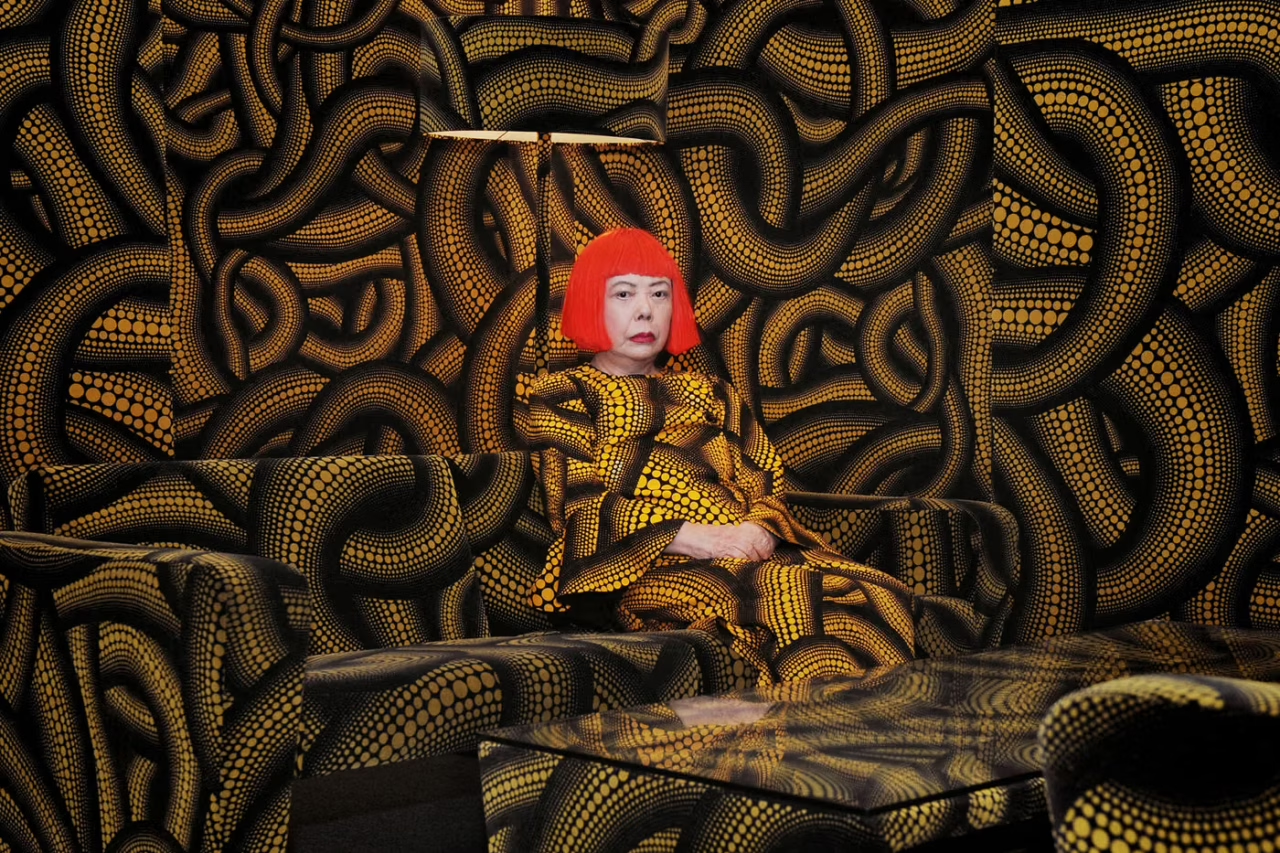

Yayoi Kusama died on August 14 at a hospital in Tokyo at the age of 97. Her studio confirmed the news in an official statement. “She continued to paint until her final days, never setting aside her brush, and continued exploration of forever love and eternal soul,” the statement read. “We will carry forward Kusama’s wishes and, through art, continue to bring hope and strength for the future to people around the world.”
The death of Kusama closes a chapter in contemporary art that began in postwar Japan, moved through New York’s avant-garde scene in the 1960s, and eventually spread her work, her dots, her mirrors, her pumpkins, her bright red bob into galleries, institutions, and popular consciousness across seven decades. She was one of the most recognized artists in the world at the time of her death, and among the most singular voices the medium has produced in the twentieth and twenty-first centuries.
She was born in Matsumoto, Japan, in 1929. As a child, she began drawing flowers not as an artistic ambition but as a coping mechanism for the hallucinations she experienced from a young age, visions of talking swarms of flowers that she later described as defining her earliest relationship with the world. The dense fields of polka dots and repeated symbols that would become her visual signature grew from the same place: a way of centering herself against the immensity she perceived in her surrounding world. Art was, from the beginning, a survival strategy. That it also became one of the twentieth century’s most distinctive creative voices was a consequence of necessity more than ambition.
The Work That Defined Her
View this post on Instagram
Yayoi Kusama moved to New York in 1958 and became part of the city’s avant-garde scene at one of its most generative moments, working alongside artists and movements that helped define the cultural history of the following decades. She used her work to confront shame, desire, and the politics of the body, embracing what she described as the outsider title that the New York art world implicitly offered her.
“I cannot imagine how I will be classified after my death,” she said in a 1965 interview. “It feels good to be an outsider.” That year, she began the Infinity Mirror Rooms installations featuring mirrored walls, reflective surfaces, and precisely placed lights that created the sensation of standing inside a universe that continued without limit in every direction. The rooms became among the most visited and most reproduced art experiences in history.
Her 1966 Venice Biennale installation, Narcissus Garden, was among her most audacious works. She installed 1,500 reflective balls on the Biennale grounds, creating a lake of reflective surfaces that explored what it means to find salvation in vanity, particularly within the art world’s own economy of prestige. She sold the balls for $2 each under the banner “Your narcissism for sale” before the Biennale shut down the performance. The conceptual precision of that gesture, commodifying the desire for self-reflection within the institution most associated with the art world’s own self-regard, announced the rigor beneath the exuberant visual surface of her practice.
A Life Lived at the Edge of Everything
Japanese artist Yayoi Kusama, famed for her polka-dot paintings, pumpkin sculptures and “Infinity Mirror Rooms,” was one of the world’s most celebrated and best-selling artists. She passed away earlier this month, according to a statement on the artist’s official website.
Read… pic.twitter.com/lXZ5fNkRWl
— CNN (@CNN) August 27, 2026
In 1977, Yayoi Kusama voluntarily checked herself into Seiwa psychiatric hospital in Tokyo. The facility gave her the stability her work required. She lived there permanently from that point, leaving during the day to work in her nearby studio. In the decades that followed, she was the subject of major surveys and retrospectives at institutions around the world, and her accessibility, the way her work could be encountered viscerally, immediately, without specialized art knowledge, made her one of the few contemporary artists who genuinely crossed between the art world and mass culture without compromising either.
Her concept of self-obliteration, the dissolution of the individual self into an endless universe, was at once a philosophical position, a psychological survival strategy, and a formal artistic methodology. It appeared in the Infinity Mirror Rooms, in the repetitive dot patterns that covered every surface of her installations, and in the way she described her own relationship to her art: not as an author standing outside her work but as someone absorbed into it. “She continued to paint until her final days.” The statement from her studio is the most fitting tribute possible for an artist who made the act of making inseparable from the act of living. She was 97 years old.
Featured image: Courtesy Of Ota Fine Arts, Victoria Miro, and David Zwirner