

Forty percent. That’s how many Gen Z consumers said they were likely to buy a pre-owned watch in the next 12 months in Deloitte’s 2025 Swiss Watch Industry Study. That number says plenty about where watch culture is right now: it’s younger, more digitally informed, and a lot more personal than the industry once expected.
For decades, a fine watch was the domain of the corner-office crowd. It sat in a velvet box, came out for board meetings and anniversaries, and mostly signaled one thing: arrival. That story isn’t gone, but it’s been seriously complicated by two generations who approach wristwear with a completely different set of values. They’re not necessarily buying a watch to look like their father. They’re buying one to look like themselves.
Wealth Is Younger Now, and the Wrist Reflects It
The economic backdrop here matters. In the first quarter of 2024, the collective wealth of millennials and older Gen Z stood at $14.2 trillion, up from $4.5 trillion four years earlier, according to Federal Reserve data. That’s not a small shift. It’s a generational increase in purchasing power that retailers across luxury categories are paying attention to.
Watches are no exception. Younger Americans—millennials and Gen Zers combined—owned $1.23 for every $1 of wealth owned by Gen Xers at the same age, according to a 2025 St. Louis Fed analysis of U.S. household wealth. That doesn’t mean every young consumer can afford a fine timepiece, but it does complicate the idea that younger buyers are uniformly priced out of luxury watches. The more relevant question is whether the watch industry is giving them a reason to buy.
Increasingly, the answer is yes. Entry-level mechanical watches from brands like Tudor and Seiko 5 have made the category more approachable. Independent watchmakers with smaller production runs have made it feel exclusive without the same level of traditional gatekeeping. And the internet has made the education piece almost frictionless.
A prospective buyer can now spend weeks learning about movements, references, case sizes, servicing histories, and market prices before ever stepping inside a boutique. That changes the relationship between the consumer and the salesperson—and, perhaps more importantly, gives the buyer far more confidence about what they actually want.
The “Watch as Identity Signal” Framework
Here’s a way to think about why younger buyers connect with watches differently than older generations did: for many boomers and older Gen Xers, a watch was primarily understood as a status signal. The brand said something about what the wearer had achieved. For millennials and Gen Z, the watch can function more as an identity signal. The reference, the colorway, the dial texture, the strap choice, the story behind the movement—all of that can communicate something about who you are, not just how much you earn.
This shift is huge for how people shop. A 35-year-old in 1990 might have walked into a jewelry store and asked a salesperson what was appropriate for their wrist. A 30-year-old in 2025 can spend six months in Reddit forums, YouTube deep dives, and Instagram saves before even visiting a retailer. They may arrive knowing the reference number, production-year variations, and exactly which dealer is gray-market versus authorized. The purchase can become almost a formality. The real decision happened online, weeks earlier.
The scale of that digital ecosystem matters. About 71% of the world’s population was online in 2024, according to the International Telecommunication Union. Platforms such as Instagram, TikTok, and YouTube have consequently become important discovery and education channels for watches, turning celebrity appearances, collector content, and wrist shots into sources of inspiration and demand.
The result is an increasingly participatory watch culture. Someone who has never owned a mechanical watch can learn the difference between an automatic and manually wound movement, compare vintage references, watch a restoration video, and follow a collector’s buying journey—all before making a first purchase.
What Young Collectors Are Actually Buying

Sports watches still dominate. Submariner-style dials, tool watches with rotating bezels, chronographs with racing heritage, anything with a bracelet that feels substantial on the wrist. But dress watches are gaining ground among younger buyers, particularly slim profiles in the 36mm to 38mm range that pair well with the current fashion moment of tailored, quiet-luxury dressing.
Pre-owned is the other story. Deloitte’s 2024 research found that growth in the pre-owned watch market was outpacing the primary market, and the firm predicted that the pre-owned market could become as large as the primary market within the following decade. The same research points to interest in vintage and neo-vintage models, discontinued references, and independent brands as important parts of the changing market.
Young collectors are part of that shift. They want specific references, not just brand names. They’re hunting for the discontinued dial, the older case size, the discontinued bracelet variant. That’s a fundamentally different shopping behavior from walking in and asking for “a nice Omega.”
A 2024 Bank of America Private Bank survey found that 46% of Gen Z and millennial respondents in its high-net-worth sample identified as watch collectors—at least twice the rate of older generations in the study. The distinction matters: collecting, not just wearing. There’s a difference, and the industry is starting to build around it.
“No longer is collecting watches exclusively a hobby of grandparents and older generations; it is a more diverse industry. As younger buyers are drawn to entry-level luxury, vintage designs, and independent brands, watch collecting is gaining traction for pieces with strong identity and design.” — Grit Daily, May 2026
The appeal of collecting also extends beyond conventional luxury. A younger enthusiast might move between a Swiss mechanical watch, a vintage Japanese model, an independent microbrand, and a fashion-forward quartz piece. The collection does not have to follow one traditional hierarchy. What connects the pieces may simply be design, history, craftsmanship, rarity, or the personal story attached to them.
Where Style and Horology Finally Meet
For a long time, fashion people and watch people existed in parallel universes. Stylists cared about the silhouette. Collectors cared about the movement. That divide has basically collapsed. Watches now show up on runways, in editorial shoots, and in the “what I’m wearing this week” content that drives engagement across fashion platforms.
Style Rave’s own audience sits right at this intersection. The same person who’s tracking the newest Ankara prints is tracking what’s on the wrist of every model walking the Lagos or Paris shows. A well-chosen timepiece reads as part of the outfit now, not just an accessory layered on top of it.
This matters practically. If you’re building a wardrobe with intention, choosing pieces that hold meaning and age well, a considered timepiece belongs in that conversation. The best luxury watches do exactly what great tailoring does: they get better with wear, they anchor an outfit, and they say something specific about the person wearing them without needing to shout.
And this is where watch collecting becomes particularly interesting for fashion consumers. A watch can echo the architecture of a jacket, pick up the hardware on a handbag, introduce an unexpected color against a monochromatic outfit, or provide a vintage counterpoint to contemporary tailoring. It doesn’t have to dominate the look to change it.
A Practical Guide to Your First “Real” Watch
If you’re a younger buyer thinking about your first serious timepiece, here’s a concrete decision path. Don’t skip steps.
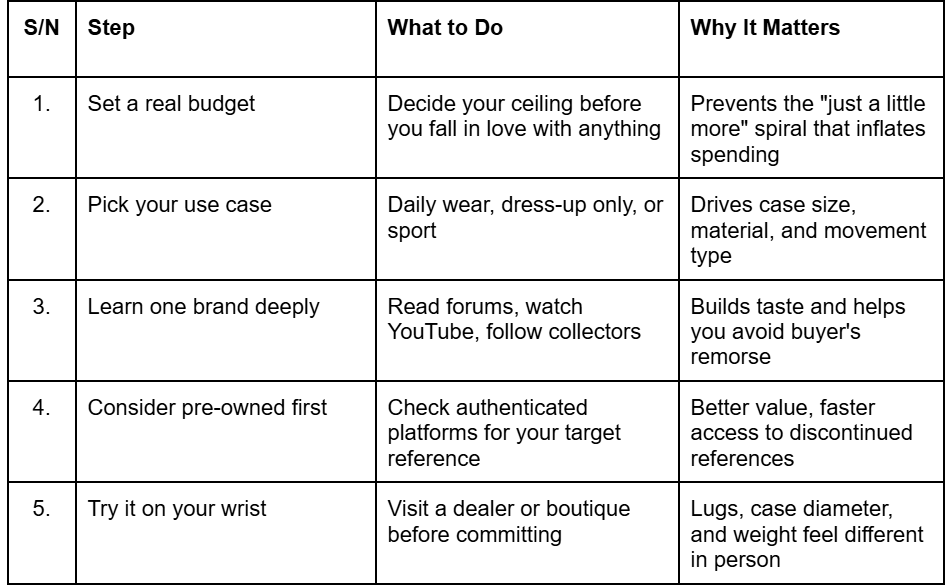
Picture this: Amara is 28. She’s been watching watch content on YouTube for three months after noticing a vintage piece on a stylist she admires. She has a $1,200 budget. She rules out smartwatches because she wants something that doesn’t need charging and that she can wear to a gallery opening without it looking out of place.
She narrows it down to a Seiko Presage Cocktail Time model versus a pre-owned Tissot PRX. She visits a dealer on a Saturday, tries both, and decides in about forty seconds. The PRX fits her wrist, the bracelet taper is elegant, and the dial color works with her entire neutral wardrobe. That’s how this purchase can actually happen for a younger buyer: research-heavy, instinct-final.
The Bigger Picture
Watch culture isn’t becoming less serious. If anything, the depth of knowledge many young collectors bring to it is remarkable, precisely because so much information is available and so many communities exist to accelerate learning. What’s changed is who gets to participate, how they discover watches, and what the watch is being asked to do.
It’s not just a symbol of achievement anymore. It’s a piece of wearable design, a quiet flex, a collectible, and sometimes an asset. For a generation that thinks carefully about what they own and why, that’s a compelling combination.
The watch industry may have taken time to catch up with this shift, but the new collector is already here. They are researching references on their phones, comparing vintage examples, watching movement breakdowns, saving wrist shots, and building collections around personal taste rather than a single definition of success.
The question is no longer simply whether younger generations want watches. It’s what kind of watch culture they want to create.
Featured image: Style Rave Studio/AI-generated Visual
—Read also