
A campus speech ended in violence on a bright September afternoon as Charlie Kirk, a high-profile conservative activist and co-founder of Turning Point USA, was shot while speaking at Utah Valley University in Orem. He later died of his wounds, and the unfortunate event has plunged a nation already raw from high-profile political attacks into fresh alarm.
What unfolded was sudden and chaotic. The shooting occurred about 12:10 p.m. local time under a tent where Kirk was taking questions. Witnesses described panic as people fled the site; cellphone video shows a single moment of violent disruption amid an event that had drawn thousands. Officials say the shot that struck Kirk was fired from an elevated position—specifically, the rooftop.
Utah Governor Spencer Cox said in a tweet: “I have ordered the flags of the United States of America and the great state of Utah to be flown at half-staff on all state facilities in recognition of the tragic passing of Charlie Kirk, who was shot and killed this afternoon while speaking at Utah Valley University.”
Kirk was a polarizing figure whose work helped mobilize young conservative voters. An attack on someone so publicly identified with a political movement sends ripples beyond Orem. It also raises questions about public safety at political events, the tone of national discourse, and how societies protect or expose their most visible voices.
The Scene and the Immediate Response
Students and attendees said the afternoon swung from debate to chaos in seconds. Video circulating online shows people ducking for cover and aides dragging injured people from the stage area. Campus officials ordered evacuations while police sealed large parts of the university as they conducted investigations.
National leaders and Political figures across the spectrum have called out the attack as a “senseless attack that took the life of a promising young American.” In a tweet, former president Barack Obama called it “despicable violence.”
The tragedy quickly became a national story, not only because of Kirk’s visibility but also because it exposed how fragile public political life has become. President Donald Trump, who himself survived an assassination attempt, expressed his grief on Truth Social. “The Great, and even Legendary, Charlie Kirk, is dead. No one understood or had the Heart of the Youth in the United States of America better than Charlie. He was loved and admired by ALL, especially me, and now, he is no longer with us. Melania and my Sympathies go out to his beautiful wife, Erika, and family. Charlie, we love you!”
What Comes Next

Charlie Kirk wasn’t just another political organizer; he was one of the most visible conservative activists in the U.S. As the founder of Turning Point USA, he consistently championed free speech, limited government, and a staunch defense of the Second Amendment. His positions on gun rights were especially firm; he frequently opposed gun control measures. According to him, law-abiding citizens should not be punished for the actions of criminals. In fact, Kirk often framed gun ownership as a safeguard against tyranny, a theme that resonated strongly with his young conservative base.
Now, in the aftermath of his death, those very beliefs are likely to shape the national conversation. Supporters may frame the tragedy as proof of why Americans need stronger protections for themselves, while critics could argue that the incident highlights the risks of unchecked gun culture. Either way, the debates Kirk fueled in life are certain to intensify in his absence.
Politically, expect a powerful rallying effect among conservative groups. Turning Point USA will face the challenge of carrying forward its vision without its founder, while allies in media and politics will elevate its message as part of its legacy. For the broader public, the shock will amplify an already heated debate over political violence, polarization, and the fragile line between advocacy and extremism.
What Investigators Are Looking At
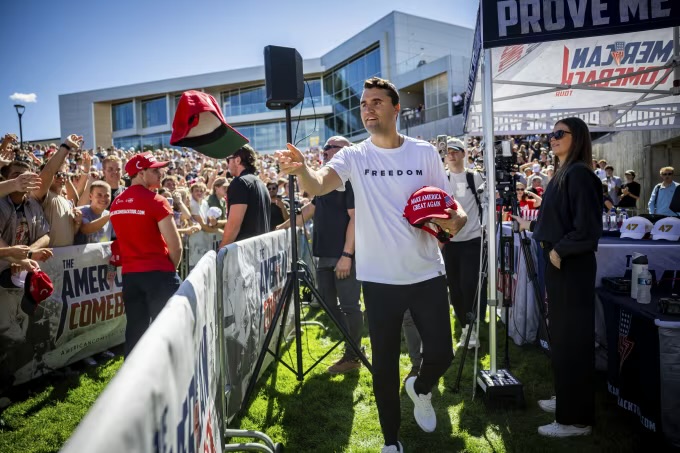
Investigators have confirmed that the fatal shot that killed Charlie Kirk came from an elevated position—specifically, the rooftop of UVU’s Losee Center, located roughly 200 yards from the speaking tent. That detail reframes the shooting from a close-range incident to what could be considered a calculated attack, heightening questions about premeditation and tactical execution.
Eyewitnesses reported that Kirk was speaking, and even responding to a question about mass shootings, when he was struck in the neck by a single bullet. Video and personal accounts describe panic erupting instantly—blood on the grass, crowds scattering, and chaos replacing curiosity.
Later, police clarified that while a person was briefly detained and questioned, no formal suspect has been confirmed in custody. The FBI, alongside the university and local law enforcement, is conducting a full-scale investigation.
The nature of the shot, a precise strike from distance during a high-profile event, adds urgency to the probe. Investigators are treating this not merely as a violent crime, but as an act of political violence. Until they uncover a credible motive or evidence, labeling it as an assassination remains premature. However, current rhetoric—including statements by Utah’s governor—signals widespread concern and offense.
The Wider Context: Political Violence and Public Events
This shooting joins a recent string of U.S. attacks on public figures and political gatherings—an alarming trend that officials and analysts say has become a feature, not an anomaly, of current political life. That doesn’t excuse this act; it explains why campuses and event organizers are now reconsidering security, access, and the balance between openness and protection.
Universities, in particular, are wrestling with the challenge of hosting public debates while protecting students and guests. Organizers must decide whether to increase screening, restrict attendance, or change venues. Critics argue that heavy security risks are chilling free speech on campuses; others say moratoria would be naïve in a time when public figures are targets. The debate has no easy answers, only tradeoffs—between safety and openness, between protest and protection.
Featured image: Getty Images
For the latest in fashion, lifestyle, and culture, follow us on Instagram @stylerave
Donald Trump Nicknames Himself The ‘Fertilization President’ At Women’s History Month Celebration