
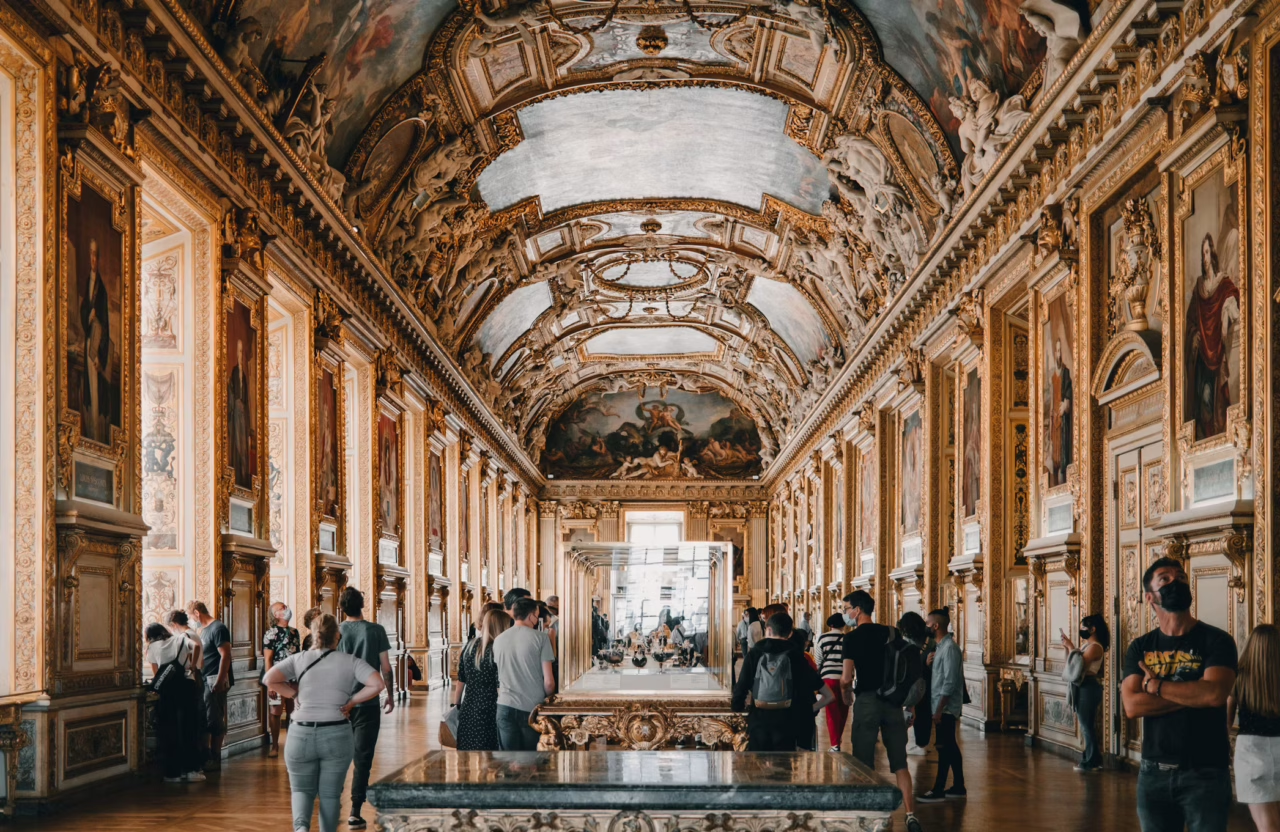

The Louvre reopened its Apollo Gallery, the Galerie d’Apollon, to the public on Wednesday, July 22, 2026, nine months after one of the most audacious museum heists in modern history. On October 18, 2025, thieves broke into the famous Paris museum and stole more than $100 million in royal jewels in a window of seven minutes.
The museum responded by removing all items and display cases from the gallery entirely, citing a desire to restore the space to its original purpose and return the painted and sculpted wall decorations to their rightful place. The public can now walk through the Apollo Gallery again, but the display cases where the jewels once sat remain empty. The stolen pieces are still missing.
Eleven suspects have been arrested across three separate operations in the weeks following the heist. Two were arrested on October 26, five more on October 29 in a Paris suburb, and four additional suspects on November 25. Six of the eleven have since been released from detention. The remaining four are awaiting trial. What the investigations have not produced is the jewelry itself. The nine stolen pieces, royal jewels belonging to Queen Marie-Amélie, Queen Hortense, Marie-Louise, and Empress Eugénie, remain unaccounted for. The only recovered item is Empress Eugénie’s crown of gold, emeralds, and diamonds, which the thieves dropped outside the museum during their escape. Everything else is gone.
Louvre Apollo Gallery Reopening: What Was Stolen and What Remains
Louvre Apollo Gallery Reopens 9 Months After Shocking $100 Million Heist with Empty Display Cases https://t.co/cwI1Gk8YGX
— People (@people) July 23, 2026
The thieves took nine pieces of exceptional historical and material value. The haul included a sapphire tiara, a sapphire necklace, and a single sapphire earring worn by Queen Marie-Amélie and Queen Hortense; a matching emerald necklace and emerald earrings worn by Marie-Louise, Napoleon Bonaparte’s second wife; a tiara and large brooch that belonged to Empress Eugénie; and a piece known as the reliquary brooch. The scale of what was taken in seven minutes, royal jewelry spanning two centuries of French imperial history, is a loss that no restitution can adequately address.
The jewelry that was not stolen and had previously been housed in the Apollo Gallery has been relocated. Louvre President Christophe Leribault confirmed that the remaining pieces are now in a secure vault with no windows in a different part of the museum.
The Apollo Gallery itself will return to its original function as a reception gallery, the purpose for which French King Louis XIV commissioned its creation in 1661. The decision to reopen the space without the jewelry is a deliberate one. The museum’s stated intention is to restore the gallery’s identity as a work of art in its own right rather than a display case for objects, however extraordinary those objects were.
The History the Gallery Carries Without the Jewels
View this post on Instagram
The Apollo Gallery’s significance is not contingent on what it once displayed. Louis XIV commissioned architect Louis Le Vau and painter Charles Le Brun to create a space that reflected his identification with the sun god Apollo in 1661. Architect Félix Duban completed the project nearly two centuries later, in 1850, producing one of the most elaborately decorated interiors in French cultural history.
The gallery directly inspired the creation of the Hall of Mirrors at the Palace of Versailles, which was completed between 1678 and 1684, a six-year project whose visual vocabulary was drawn directly from what had been achieved in the Apollo Gallery. That lineage gives the space a place in architectural history that the heist cannot erase.
What the reopening marks, beyond the return of public access, is the museum’s acknowledgment that the gallery must exist independently of the objects that once gave it its secondary identity as a royal jewelry repository. The empty cases are still present in the public imagination even when they are no longer present on the floor. The Apollo Gallery reopens to the public on July 22, carrying the weight of what it held and what was taken, and the investigation that has yet to produce the answer the world is still waiting for.
Featured image: Dat Vo/Unsplash