


The DJI Mic 3 arrives at a point when wireless audio has become almost invisible in the modern creator’s toolkit. Microphones now sit beneath jackets during interviews, clip onto shirts for street videos, and quietly handle dialogue while cameras move through increasingly chaotic environments. The challenge is no longer simply getting a microphone small enough to carry around. It is keeping the recording usable when the volume changes, the location gets noisy, several people need microphones, or footage comes from multiple cameras.
That is the territory this system is designed to occupy. Rather than treating wireless audio as a single connection between one microphone and one camera, DJI has built the setup around a broader production workflow. Adaptive Gain Control, 32-bit float internal recording, multi-transmitter support, timecode, dual-band transmission, and direct device connectivity all address problems that tend to appear once a shoot moves beyond a controlled setup.
Small Hardware With a Practical Advantage
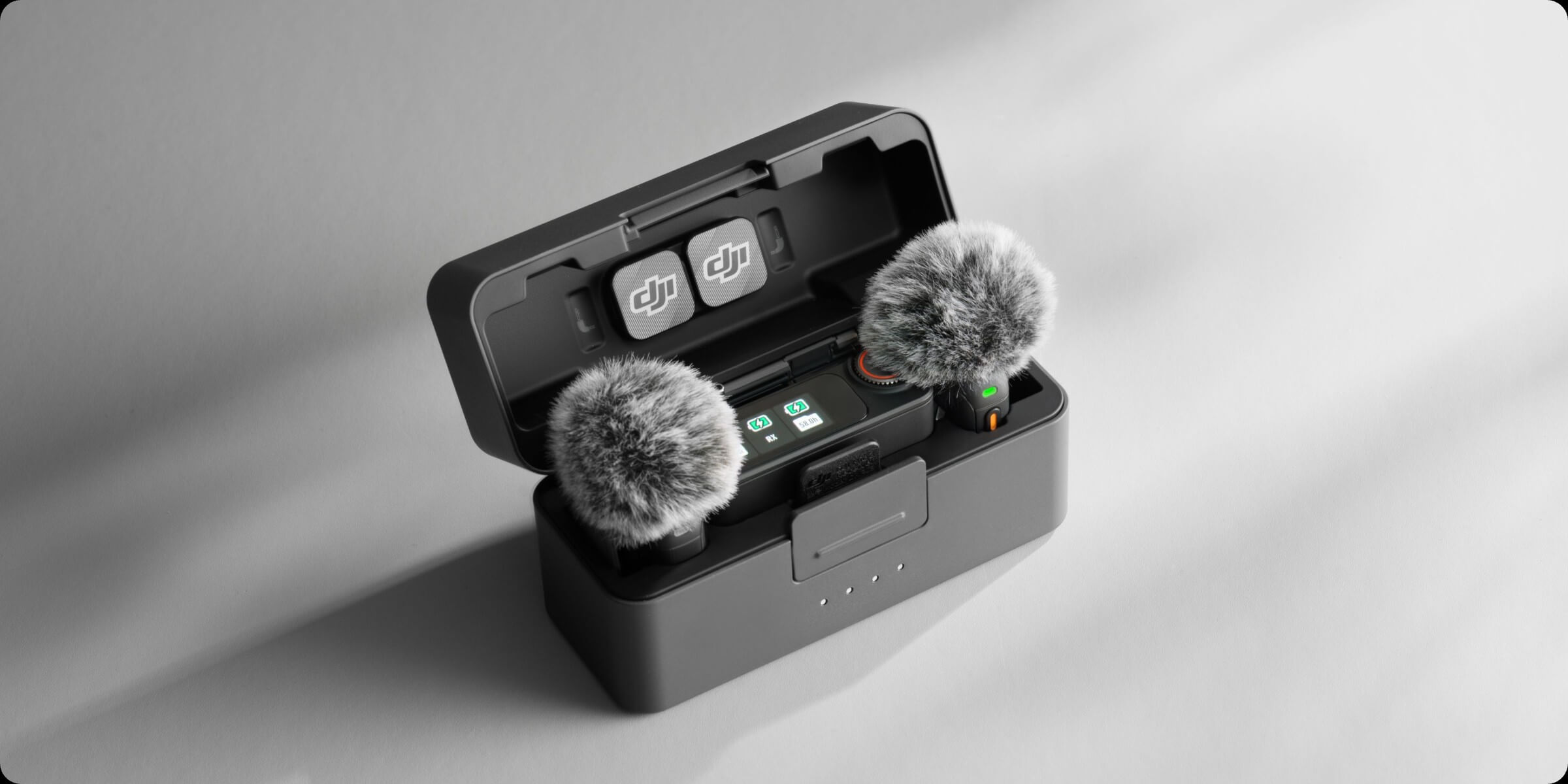
The transmitter is compact enough to disappear into a production rather than dominate it. It can be attached magnetically or with a clip, while the detachable clip rotates to accommodate different mounting positions. That flexibility becomes useful when the microphone needs to sit sideways, upside down, or in a less conspicuous position on clothing.
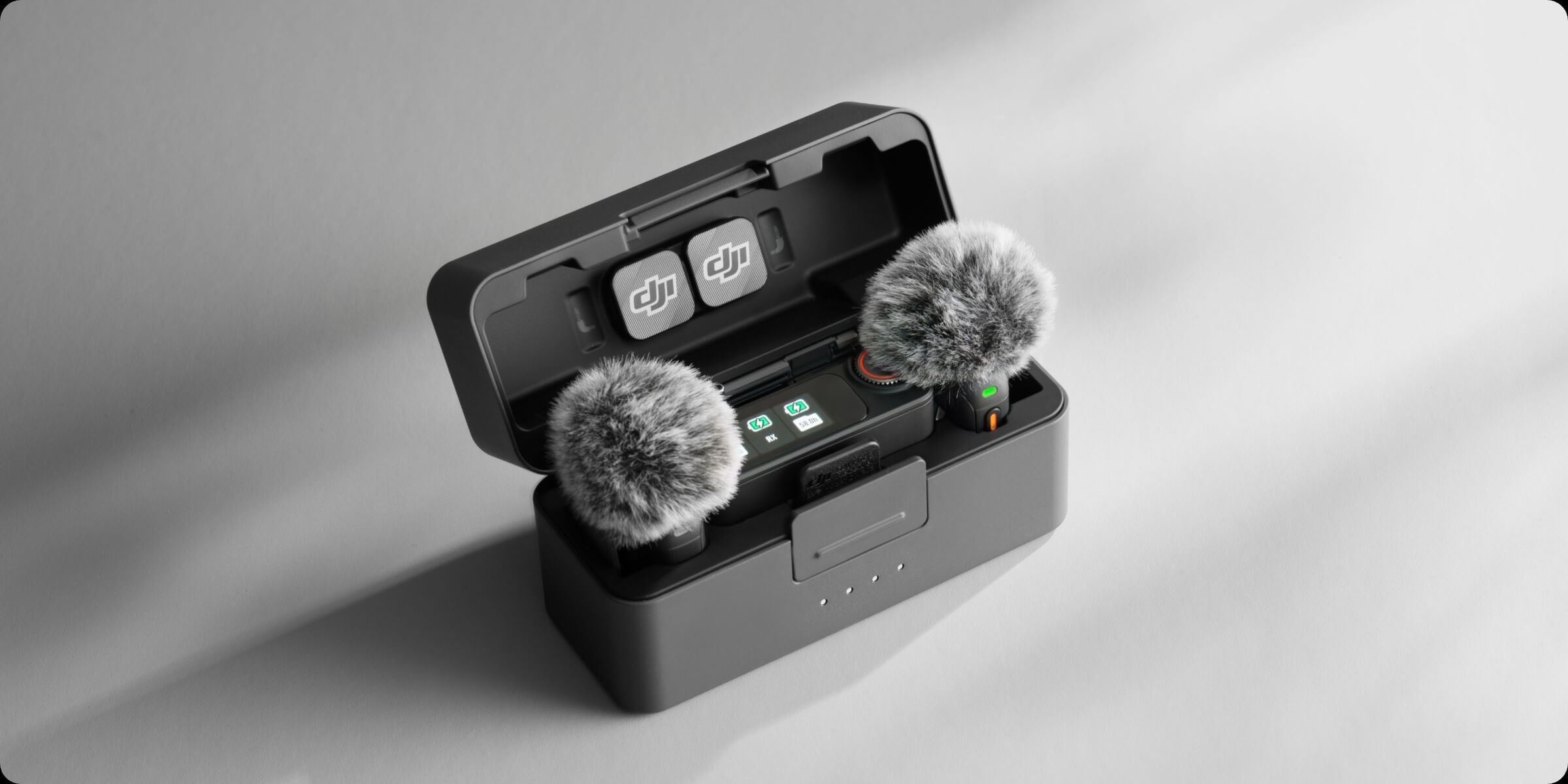
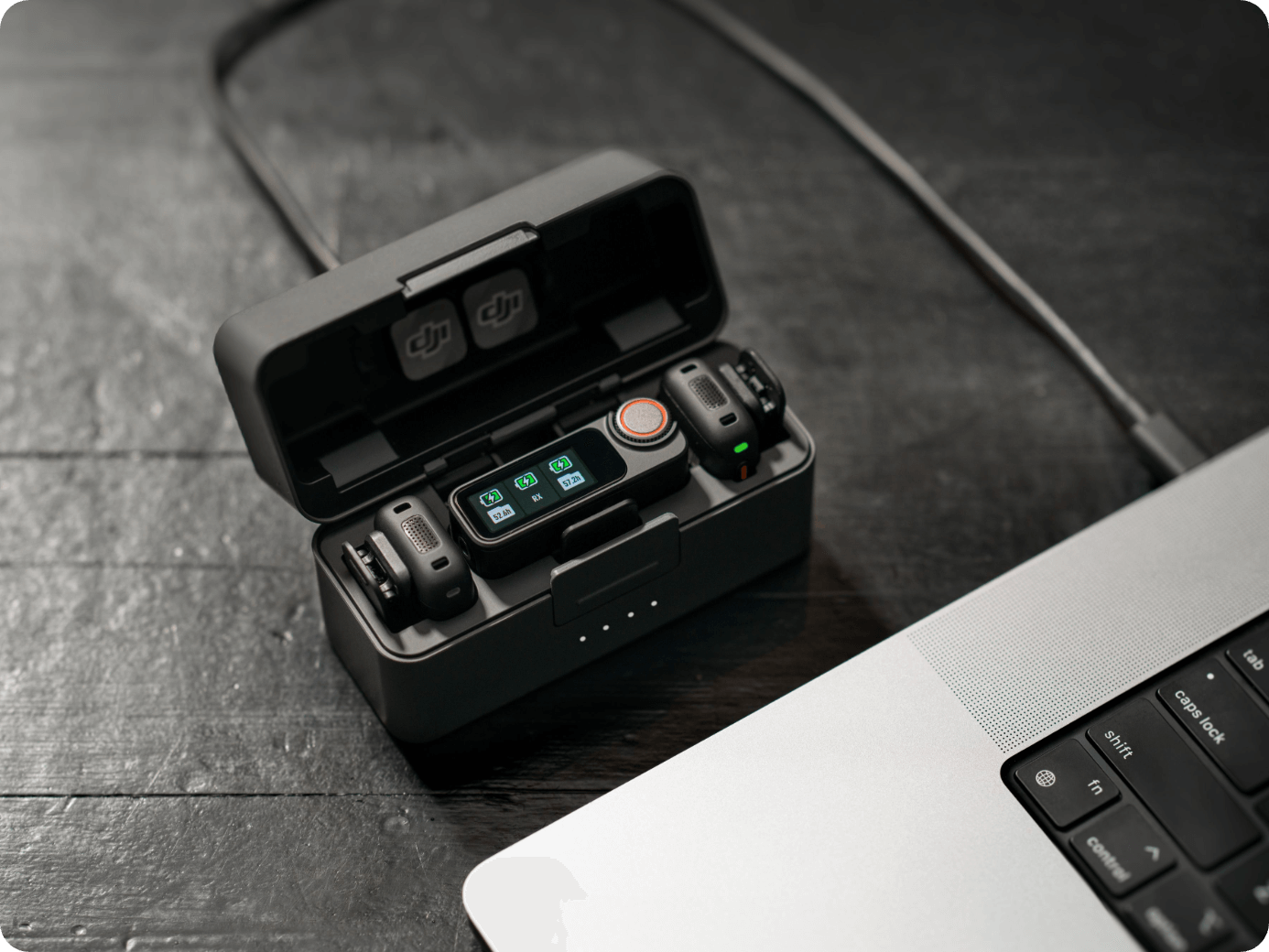
The charging case is equally considered. Two transmitters and the receiver fit inside without requiring the windscreens or magnetic accessories to be removed. There is also space for the magnets and locking audio adapter cable. It is a modest design decision, but one that makes the entire kit easier to grab and go when every component needs to stay together.
Audio That Adapts as the Environment Changes
A recording can move from quiet conversation to laughter, applause, traffic, or shouting in seconds. Fixed gain settings can make those transitions difficult to manage, particularly when there is no opportunity to monitor every change. The DJI Mic 3 addresses that problem with Adaptive Gain Control, including an Automatic mode designed to reduce the risk of clipping when volume suddenly rises.
There are also three voice tone presets: Regular, Rich, and Bright. Regular provides a clean, balanced starting point, while the additional profiles allow creators to shape the character of the recording before it reaches the editing timeline.
Noise cancellation is divided into Basic and Strong levels. Basic is intended for relatively controlled spaces where fans, air conditioning, and room reflections are the main distractions, while Strong is better suited to noisier surroundings. With the windscreen attached, the transmitter is also designed to reduce wind and other environmental noise during outdoor recording.
Four Transmitters Expand the Production
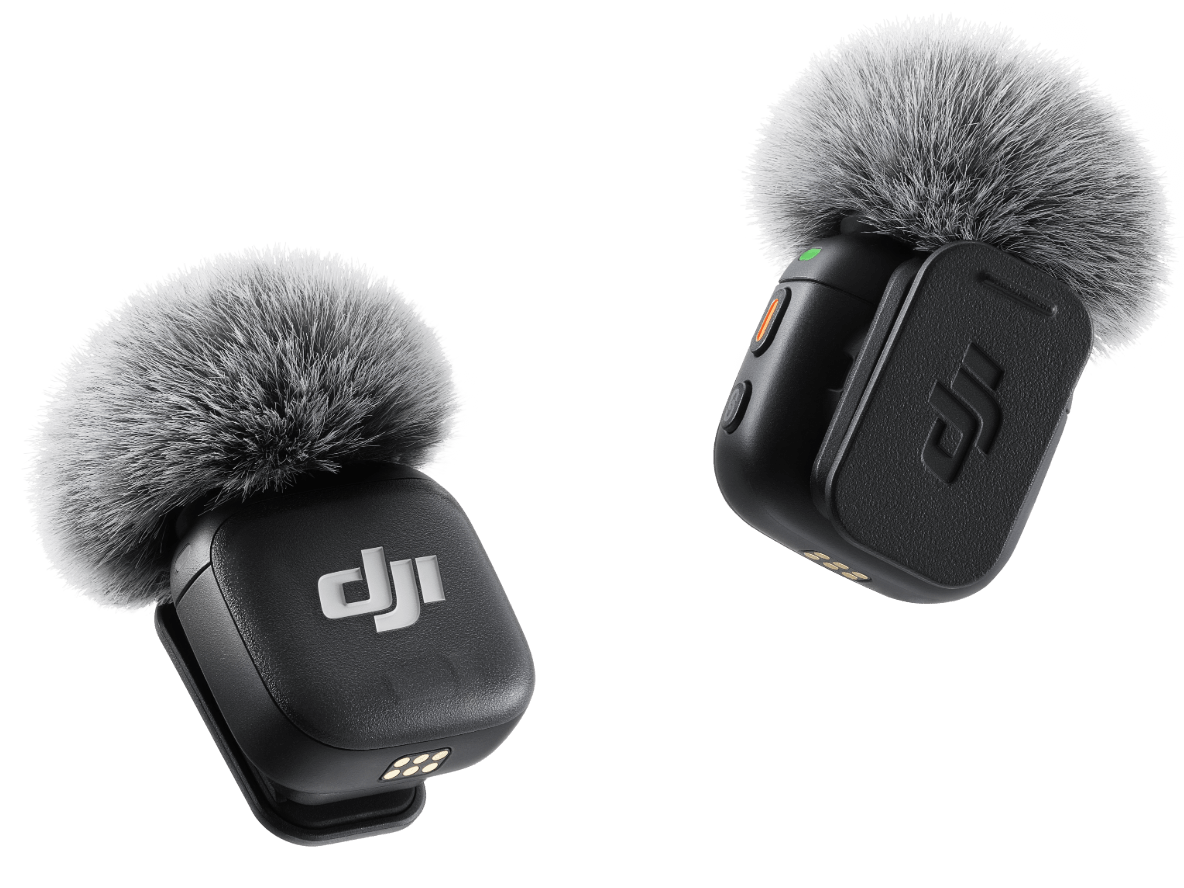
The more people involved in a production, the more complicated wireless audio becomes. A receiver can connect with up to four transmitters, allowing four audio sources to be recorded simultaneously. That immediately makes the system relevant beyond the solo creator.
Consider a four-person interview, a small documentary crew, a panel discussion, or an event where several speakers need individual microphones. Instead of building the audio setup around one person at a time, the system can accommodate a larger group. The main receiver can also synchronize audio to up to seven additional receivers, giving multi-camera productions another layer of flexibility.
Channel configuration is similarly adaptable. Mono and Stereo modes let creators decide how sources should be handled, while Quadraphonic mode can provide four independent audio tracks when paired with compatible Sony cameras or computer software. For editors, having individual voices separated into their own tracks is considerably more useful than receiving one mixed file and attempting to isolate them afterward.
Wireless Reliability Is Part of the Equation
Wireless audio has an obvious vulnerability: the connection itself. Crowded locations can introduce interference, particularly at trade shows, events, and other spaces filled with wireless devices. The DJI Mic 3 uses automatic frequency hopping between 2.4 GHz and 5 GHz bands, with a claimed transmission range of up to 400 meters under specified conditions.
The system can also transmit lossless 48 kHz, 24-bit audio when Lossless Audio is enabled. That gives creators a high-fidelity wireless option while retaining the convenience of a compact transmitter-and-receiver setup.
More importantly, however, the transmitters can record independently.
32-Bit Float Recording Creates a Safety Net
The internal recording system may prove to be one of the most useful features for unpredictable shoots. The transmitters support 32-bit float recording and can save two files: the original recording and an algorithm-enhanced version.
That matters when the soundscape is constantly changing. A speaker whispering one moment and raising their voice the next creates a very different recording challenge from a controlled studio interview. With 32-bit float capture, editors have considerably more flexibility when adjusting levels during post-production.
Internal recording also creates a backup if the wireless connection encounters trouble. Rather than relying entirely on the audio reaching the camera, the transmitter is simultaneously creating its own record of the performance.
Timecode Makes Multi-Camera Work Less Tedious
For larger productions, audio synchronization can become one of those invisible jobs that quietly consumes hours. The system incorporates timecode into its workflow, with the transmitter able to embed timecode during internal recording and the receiver supporting both timecode input and output.
DJI states that the system can maintain less than one frame of drift over 24 hours under its specified conditions. For multi-camera shoots, that is designed to make aligning footage and audio considerably faster, reducing some of the manual work that normally happens before an edit can properly begin.
Battery Life Built Around Long Shoots
Shop here
Battery management is another area where the system takes a production-minded approach. Each transmitter can operate for up to eight hours, while the receiver can reach up to 10 hours. The charging case extends total operating time to as much as 28 hours.
A five-minute charge can provide up to two hours of use for the transmitter and receiver, making a quick top-up possible between setups. A full charge takes around 50 minutes with supported fast charging.
One System, Several Ways to Create
The DJI Mic 3 ultimately stands out because it does not lock creators into one recording method. It can function as a conventional wireless microphone system, record internally, connect directly to compatible DJI Osmo devices through DJI OsmoAudio, or connect directly to a phone over Bluetooth.
That flexibility reflects how video production actually works now. A creator might shoot a polished interview in the morning, capture vertical social footage in the afternoon, and record a quick phone video later that evening. Carrying one audio system across those situations is considerably more useful than having a microphone optimized for only one.
The DJI Mic 3 is therefore less interesting as a collection of specifications than as a response to the messy realities of modern production. Its strongest idea is the combination of reliable transmission, backup recording, flexible channel management, precise synchronization, and compact hardware, all designed to give creators fewer things to worry about once the camera starts rolling.
Featured image: DJI
—Read Also